
Affiliate Disclosure: Some of the links in this post are affiliate links. This means we may earn a small commission if you make a purchase through these links—at no extra cost to you. We only recommend products and tools that we genuinely believe will help you with your woodworking projects.
A wood lathe revolutionizes shaping by rotating your stock. You achieve perfect radial symmetry and consistent diameters with ease. Its continuous rotation provides considerable cutting contact, allowing moderate hand pressure to remove material rapidly. You can create everything from simple spindles to intricate bowls in one session, maximizing both precision and creative potential. Understanding its full capabilities will considerably elevate your craft’s efficiency and scope.
- Key Takeaways
- What Is a Wood Lathe and How Does It Work?
- How a Wood Lathe Creates Perfectly Symmetrical Designs
- How a Wood Lathe Speeds Up Shaping and Reduces Effort
- Why a Wood Lathe Is Your Most Versatile Woodworking Tool
- From Bowls to Spindles: Woods and Projects a Lathe Can Tackle
- How Does Using a Wood Lathe Enhance Creative Potential?
- Building Your Skills: Why a Wood Lathe Is a Master’s Tool
- How a Wood Lathe Delivers a Professional Finish With Less Effort
- How a Wood Lathe Minimizes Material Waste
- Setting Up Your Wood Lathe for Essential Safety
- Essential Safety Gear for Wood Lathe Operation
- Maintaining Your Wood Lathe for Long-Term Performance
- Optimizing Your Workspace for Wood Lathe Safety and Efficiency
- Choosing and Starting Your First Wood Lathe Project
- Key Takeaways: Maximizing Your Wood Lathe’s Advantages
- Frequently Asked Questions
- Conclusion
Key Takeaways
- Enables the creation of perfectly symmetrical and balanced designs with consistent diameters.
- Allows for rapid and efficient material removal, shaping wood quickly with controlled cuts.
- Provides versatile functionality for drilling, sanding, and complex profiling in a single setup.
- Facilitates high precision and repeatability for producing duplicate turnings with uniform results.
- Unlocks creative potential for three-dimensional sculptural work, from simple spindles to intricate bowls.
What Is a Wood Lathe and How Does It Work?
A wood lathe is a specialized machine you use to cut, sand, and shape wood by rotating a workpiece against stationary cutting tools.
It’s fundamentally different from a metal lathe, which handles harder materials like steel. You mount your stock between the headstock and tailstock, and the motor drives its rotation. You’ll control the speed via a simple pulley system.
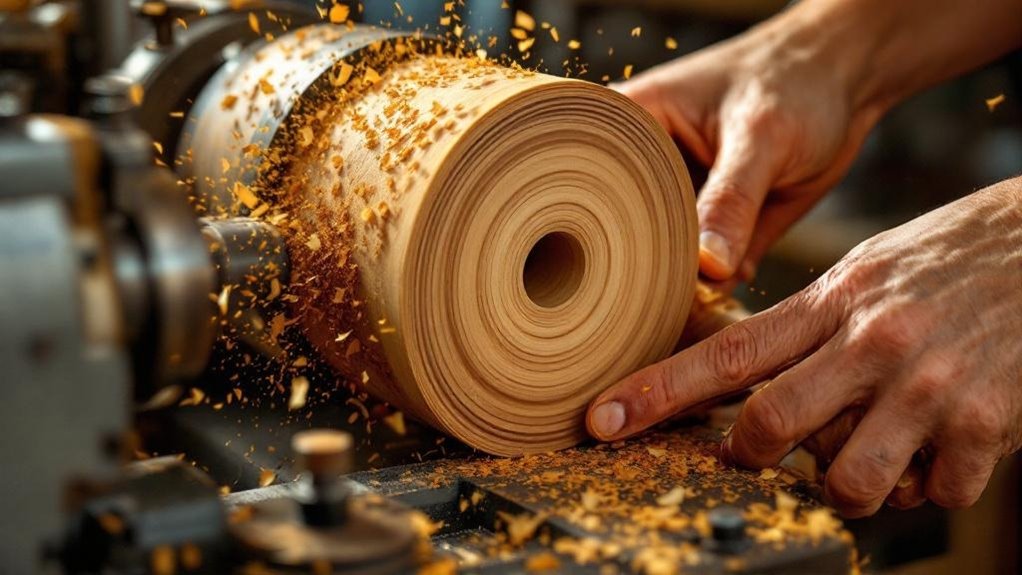
As the workpiece spins, you apply your gouges, chisels, and scrapers to its surface. This continuous rotation lets you remove material uniformly, shaping the wood with precision. You can drill, sand, and create complex profiles.
Its design is intentionally less complex than a metal lathe, keeping it accessible and cost-effective for dedicated woodworking.
How a Wood Lathe Creates Perfectly Symmetrical Designs
Now let’s explore how this rotational process directly produces symmetrical designs.
In wood turning, you secure a workpiece between centers or a chuck, and it spins on a fixed axis. You then present your stationary cutting tool to the rotating wood. This action removes material uniformly from the entire circumference with each pass.
Because the cutting force is applied continuously around a single axis, every point on the workpiece receives identical treatment. You achieve perfect radial symmetry as you shape the wood; any contour you cut is instantly mirrored around the full rotation.
This single-axis rotation ensures identical treatment for every point, instantly mirroring each cut into perfect radial symmetry.
This fundamental mechanical principle guarantees bowls, spindles, and other turnings maintain consistent diameters and balanced profiles that are aesthetically and structurally sound.
How a Wood Lathe Speeds Up Shaping and Reduces Effort
You’ll achieve efficient material removal by applying your tools to the spinning blank, as the lathe’s rotation does the bulk of the work for you.
This directly facilitates rapid progress, dramatically shortening the time from a rough billet to a shaped form.
You’re not fighting the material; you’re guiding it, which drastically reduces your physical effort.
Efficient Material Removal
- The workpiece’s rotation presents its entire circumference to your stationary tool, enabling continuous cutting contact.
- You leverage mechanical advantage, translating moderate hand pressure into significant stock reduction.
- This process generates uniform ribbons of waste, a clear indicator of peak cutting efficiency.
- Systematic passes quickly define profiles, hollow vessels, and duplicate turnings with repeatable precision.
Rapid Progress Facilitation
Through the rotational force of a lathe, you accelerate material removal far beyond the capabilities of static hand tools. This consistent, powered rotation enables swift shifts from roughing to finishing, maintaining a smooth workflow with minimal downtime.
You’re not expending energy forcing cuts; the machine’s motion reduces physical strain, allowing you to tackle intricate designs without fatigue. The inherent symmetry of lathe work eliminates tedious multiple passes and corrections inherent in manual shaping, directly saving hours.
This rapid facilitation of progress enhances productivity, permitting quick adjustments during the process for a faster project turnaround. Ultimately, this velocity grants you the bandwidth to experiment and create unique forms efficiently, without compromising the quality of your finished product.
Why a Wood Lathe Is Your Most Versatile Woodworking Tool
Among essential tools in a workshop, a wood lathe stands apart for its remarkable versatility, enabling you to produce both simple spindles and intricate bowls with consistent precision.
Its core strength lies in generating a wide range of shapes from a single spinning workpiece, a fundamental capability that few other tools can offer with such control. You achieve exact symmetry and intricate detailing through direct tool manipulation, transforming rough stock into refined forms efficiently.
This versatility directly facilitates:
- Precision Symmetry: You consistently replicate complex profiles and maintain perfect radial balance through controlled cuts.
- Unmatched Form Variety: You generate everything from coves and beads to hollow vessels from one mounted blank.
- Material Flexibility: You adapt your technique to effectively turn both dense hardwoods and softer species.
- Process Efficiency: You shape and smooth wood rapidly, replacing laborious hand tool work with mechanized precision.
From Bowls to Spindles: Woods and Projects a Lathe Can Tackle
This potential for varied forms naturally leads to a practical consideration: what specific woods and projects align with a lathe’s capabilities?
You can use almost any stable wood, from hardwoods like maple and walnut for durable bowls to softwoods like pine for practice spindles. Its primary function is to efficiently remove material to create symmetrical objects.
For projects, you’ll craft functional items like table legs, knobs, and platters, utilizing the lathe’s precision for consistent diameters and complex profiles.
You also create decorative hollow forms and vases, where the spinning wood allows for refined internal and external contours. This process maximizes material use, transforming rough blanks into finished pieces with minimal waste.
How Does Using a Wood Lathe Enhance Creative Potential?
You’ll access true artistic freedom by manipulating wood in the round to realize forms that are otherwise impossible.
This tool directly expands your design horizons through precise, rapid shaping that encourages bold experimentation.
You’re not just following a plan; you’re iterating designs in real-time to develop a distinct creative voice.
Unlocking Artistic Freedom
- The rotating workpiece becomes a canvas for three-dimensional sculpture, allowing for the creation of complex curves and hollow forms like vases.
- Precision turning guarantees symmetrical perfection, giving you the control to execute intricate patterns and consistent decorative elements.
- You can combine various operations—like drilling, sanding, and parting—on the same machine during a single creative session, streamlining your workflow.
- The process fosters a direct connection between your conceptual design and its physical realization, enabling immediate feedback and iterative refinement.
Expanding Design Horizons
Building on the artistic freedom activated through direct design-to-material connection, a wood lathe elevates creative potential by fundamentally expanding your achievable design vocabulary.
The machine reveals complex geometry, like intricate vases and fluted spindles, that’s impractical with hand tools alone. This process directly contributes to expanding design horizons.
The precision offered by a wood lathe is critical; it provides the control for perfect symmetry and fine details, letting you execute refined concepts without manual inaccuracies.
You’re empowered to push traditional boundaries, adapting techniques for both functional and artistic work. This versatility fosters true innovation, allowing you to develop a unique portfolio defined by personal artistic expression and technical mastery.
Building Your Skills: Why a Wood Lathe Is a Master’s Tool
- It develops exceptional hand-eye coordination as you learn to fluidly maneuver tools against a spinning workpiece.
- The lathe trains you in nuanced tool control for executing intricate profiles and complex geometries with confidence.
- It fosters advanced problem-solving, pushing you to innovate when designing and turning challenging pieces.
- The platform enables continuous technique refinement, allowing you to adopt new methods and expand your creative repertoire systematically.
How a Wood Lathe Delivers a Professional Finish With Less Effort
Achieving a professional finish on your workpieces is often where the lathe’s efficiency becomes most apparent. Its rotating motion facilitates efficient material removal, drastically cutting down the time you’d spend manually shaping. You’ll gain precision capabilities for symmetrical designs and intricate details, which are fundamental for that professional-grade appearance. Consistent spindle speed and tool control yield remarkably smooth cuts directly from the tool, meaning you’ll require far less sanding later. This streamlined workflow lets you move rapidly from a blank to a finished product.
| Lathe Function | Resulting Benefit | Finish Impact |
|---|---|---|
| Controlled Rotation | Efficient Material Removal | Reduced Hand-Sanding |
| Speed Consistency | Smooth Tool Cuts | Polished Surface |
| Precision Tool Rest | Symmetrical Detailing | Professional-Grade Appearance |
Combined with sharp tools, this process delivers superior results with considerably less physical effort.
How a Wood Lathe Minimizes Material Waste
You’ll achieve precision in shaping by using exact measurements that minimize excess material loss.
The lathe’s efficient material removal transforms large pieces into intricate designs with minimal leftover scrap.
This process guarantees enhanced wood utilization by streamlining your workflow and reducing waste throughout production.
Precision In Shaping
Because a wood lathe provides exact control over the cutting tool, it removes material with surgical precision, eliminating only what’s necessary to reveal the final form. This precision in shaping directly minimizes waste.
You dictate the exact depth and profile of every cut, transforming a rough blank into a symmetrical component without generating random offcuts. The inherent rotational accuracy guarantees uniformity, so you’re not forced to discard pieces due to dimensional errors.
You maximize the utility of each blank, as the lathe facilitates intricate detailing that repurposes wood which might otherwise be scrap. This controlled process yields fewer mistakes, making your entire operation more material-efficient.
- Symmetrical Perfection: Achieve flawless uniformity around the central axis, confirming every pass removes only the predetermined excess.
- Detailed Reclamation: Intricate beads, coves, and profiles turn marginal sections of a blank into integral, beautiful design elements.
- Predictable Yields: The fixed rotational path allows you to precisely plan your cuts, knowing the exact volume of material you’ll remove.
- Error Reduction: Direct tool control mitigates slip-ups that create irreparable flaws and force you to discard the workpiece.
Efficient Material Removal
As the lathe’s rotating action rapidly removes bulk material, it eliminates the tedious, time-consuming phases of shaping a blank, letting you focus on the precise, finish-oriented cuts that define the final form.
This fundamental process of efficient material removal is a primary advantage. You achieve rapid stock reduction directly through the tool’s interaction with the spinning workpiece, a method far faster than manual carving or sawing.
The continuous cutting action allows for a smoother workflow, dramatically accelerating project turnaround. You maintain control with fine adjustments during the cut, ensuring you remove only what’s necessary to reach your final dimensions.
This precision minimizes excess waste, saving both time and material while boosting overall productivity.
Enhanced Wood Utilization
A wood lathe’s precise and controlled cutting inherently promotes enhanced wood utilization. You achieve this by removing only the material necessary for your design, directly minimizing waste from excess trimming.
The lathe’s rotating motion lets you shape intricate forms from a single blank, often leaving very little leftover. This efficient transformation means you maximize each workpiece.
Additionally, small scraps aren’t automatically trash; you can mount them for turning into knobs, finials, or other small components, enhancing your material efficiency. This systematic approach directly reduces raw material costs over time and supports sustainable workshop practices by managing resource consumption with authority.
- Precision Shaping: The tool’s control allows for intricate designs that inherently conserve material, leaving minimal waste.
- Maximized Blanks: You efficiently transform entire wood blanks into finished products, utilizing the majority of the stock.
- Repurposed Scrap: Even small offcuts become viable for secondary projects like turning tool handles or decorative inserts.
- Sustainable Practice: This controlled process reduces overall wood consumption, aligning your work with cost-effective and environmentally responsible craftsmanship.
Setting Up Your Wood Lathe for Essential Safety
Your wood lathe demands a safety-first setup before any project begins.
Start with a thorough inspection. Confirm all components are secure and in perfect working order; a loose tool rest or tailstock compromises fundamental safety when working.
Begin with a meticulous inspection. Verify every component is tightly secured; a single loose part undermines the entire operation’s safety.
Next, scrutinize your stock. Reject any wood with significant defects like cracks or knots, as these can fail catastrophically at speed.
Your workspace must be meticulously clean and well-lit; clear away debris and guarantee ample lighting to maintain clear visibility of your cutting tools and the workpiece.
A cluttered or dim area invites accidents. This disciplined preparation is non-negotiable, establishing a controlled environment that directly supports secure and precise turning operations.
Essential Safety Gear for Wood Lathe Operation
Operation demands the right personal defense, starting with impact-resistant eyewear to protect your eyes from debris. Never operate your lathe without this essential safety gear.
You must also wear a dust mask to avoid inhaling fine particles. Don proper hearing protection; the lathe’s noise can cause permanent damage.
Your clothing must be fitted to eliminate snag hazards, and you need sturdy, non-slip boots for stable footing. Integrating these items into your routine isn’t optional—it’s fundamental to safe practice.
- Impact-Resistant Eyewear: Mandatory for deflecting wood chips and projectiles.
- Fitted Work Attire: Prevents entanglement with the rotating spindle and workpiece.
- Dust Mask/Respirator: Filters harmful fine dust from your airways.
- Hearing Protection: Earmuffs or plugs safeguard against prolonged noise exposure.
Maintaining Your Wood Lathe for Long-Term Performance
Proper safety gear sets the stage for effective work, but you’ll only get that performance if your lathe itself is maintained.
The cornerstone of maintaining your wood lathe for long-term performance is a disciplined inspection routine. You must regularly inspect the wood lathe for any wear and tear, focusing on belts, bearings, and drive components.
Adhere to a strict cleaning schedule to prevent sawdust accumulation from causing mechanical bind or premature wear. Follow the manufacturer’s lubrication and alignment specifications precisely.
Replace worn parts immediately to avoid compromising operational integrity and safety. Finally, store your lathe in a clean, dry environment to prevent corrosion.
This systematic care guarantees consistent precision and extends the machine’s service life dramatically.
Optimizing Your Workspace for Wood Lathe Safety and Efficiency
Start by positioning your lathe to allow ample clearance around the machine, ensuring you’ll maintain a stable stance during operation.
Then, you must install bright, focused lighting to eliminate shadows and glare across your workpiece.
Finally, always verify that your safety glasses are secured and that you’ve removed any loose clothing or jewelry before starting the motor.
Strategic Lathe Placement
Always position your wood lathe in a well-lit area to guarantee maximum visibility, as this directly reduces accident risks from poor lighting while working with a wood. This foundational step is part of a broader strategy for safe, efficient placement.
Your lathe’s placement dictates operational stability and long-term safety. Anchor it on a perfectly level, solid surface to eliminate hazardous vibration during cuts. Maintain generous clearance around the machine for unimpeded movement and tool access. Integrate a dust collection system at the source to protect your health and the lathe’s mechanics.
Finally, situate it near dedicated power outlets to avoid dangerous, tangled extension cords that compromise electrical integrity.
- Secure the lathe on a stable, level foundation to prevent operational vibration.
- Allow ample perimeter space for safe movement and tool handling.
- Employ immediate dust collection to maintain a clean, hazard-free environment.
- Position near fixed power sources to eliminate cord-related trip and electrical risks.
Enhanced Visibility Conditions
Since ideal lighting reduces your risk of accidents and improves the accuracy of your cuts, you should focus the primary illumination directly at the lathe and workspace to eliminate obscuring shadows. Insufficient lighting compromises your craftsmanship, leading to material waste and time-consuming errors.
You’ll achieve enhanced visibility conditions by employing adjustable lamps or overhead systems that you can precisely position. Regularly assess your lighting before starting any task to prevent eye strain, a critical factor for comfort during intricate turning work.
These optimized conditions directly impact your precision and safety, allowing you to clearly see the tool’s interaction with the spinning stock and make the minute adjustments necessary for flawless results.
Essential Safety Equipment Use
Operating a wood lathe safely requires one to consistently use essential protective gear. You’re managing significant rotational forces and generating airborne debris, making personal protective equipment non-negotiable for long-term, efficient work. Your first defense is always certified safety goggles; they seal against your face to stop fine dust and larger chips that regular glasses miss.
You must integrate this gear into your workflow without exception. Complement your eyewear with these other critical items:
- Secure, Close-Fitting Clothing: Avoid loose sleeves or dangling jewelry that can instantly snag in the spindle or chuck.
- High-Fidelity Hearing Protection: Use earmuffs or plugs to attenuate the prolonged, damaging noise from the motor and cutting action.
- Sturdy, Closed-Toe Footwear: Wear shoes with non-slip soles to maintain solid footing and protect against dropped workpieces or tools.
Choosing and Starting Your First Wood Lathe Project
Initiating your first wood lathe project requires selecting an appropriate lathe, where factors like size, power, and variable speed control are fundamental for effective material shaping.
When choosing and starting your first wood lathe project, make certain you select a manageable task, like a basic spindle, to concentrate on foundational tool handling.
You must prepare correctly; use a stable wood blank and confirm your gouges and skew chisels are exceptionally sharp for clean cuts and to reduce vibration.
Don’t neglect final safety checks before engaging the drive.
Leverage detailed instructional content to grasp essential techniques, which accelerates skill development and guarantees your initial foray into turning is both productive and secure.
Key Takeaways: Maximizing Your Wood Lathe’s Advantages
How can you fully leverage a wood lathe’s precision and efficiency to elevate your work? You’ll achieve superior results by integrating disciplined technique with the machine’s inherent capabilities. Focus on tool control and sharpening your cutting tool to guarantee clean, effortless material removal, directly impacting your finished product’s quality.
This approach is central to maximizing your wood lathe’s advantages, transforming raw stock into refined pieces with remarkable efficiency.
- Master Tool Presentation: A sharp, correctly presented cutting tool reduces tear-out and sanding time, letting the wood’s natural beauty emerge.
- Sequence Your Cuts: Plan roughing, shaping, and finishing passes to work the material methodically, saving time and improving accuracy.
- Select Appropriate Speeds: Match the lathe’s RPM to your workpiece’s diameter and the specific cutting operation for best control and surface finish.
- Embrace Repetition: When producing multiples, establish consistent setups and measurements to achieve identical results with greater speed.
Frequently Asked Questions
What Are the Advantages of a Wood Lathe?
You’ll achieve precise, symmetrical designs while working efficiently and reducing physical effort. It’s a versatile tool that sparks creativity and skill development, letting you tackle everything from spindles to unique bowls.
What Are the Disadvantages of Using a Lathe?
You’ll face a deafening roar of noise and a mountain of hazardous dust. It’s a costly, inherently dangerous machine that violently limits you to symmetrical forms, stifling creative design possibilities from the start.
What Is the Best Wood to Turn on a Lathe for Beginners?
Start with softwoods like pine or cedar; you’ll find they cut easily. Basswood is also a top pick for its fine, forgiving grain. Avoid dense hardwoods initially, and always work with properly dried, defect-free stock.
Can You Make Money From Woodturning?
Yes, you can profit from woodturning. Focus on high-demand, custom pieces and sell them through online platforms or craft fairs. Developing a niche and offering workshops will greatly boost your revenue streams.
Conclusion
Test the theory that a lathe merely replicates old forms. You’ll prove it creates new ones. By mastering tool control and understanding wood grain under rotation, you open up a unique dialogue between material and maker. This isn’t just turning; it’s a technical exploration of symmetry and form found nowhere else in the craft, revealing possibilities hidden within the wood itself.